How to learn AI for free in Africa: a 12-week plan
Anyone can learn to use AI well this week, for free and without code. Learning to build AI takes months of steady work in Python, basic statistics and real data, and that too can be done for free. The 12-week plan below covers both: two free introductory AI courses, the basics of Python and data, and a small project on data from where you live, shared with an African community. That project will show employers more than any certificate.
By the RootedPrompt editorial team. Published 9 October 2026.
Search "ai course" from Kampala or Lagos and you will find hundreds of offers: bootcamps, certificates, masterclasses, many of them priced in dollars and promising a new career in weeks. It is hard to tell which are worth your time, and easy to conclude that learning AI is for people who can pay.
It is not. The best introductory AI courses are free, the tools for practising run in a web browser, and some of the strongest AI communities in the world are African. What learning AI really costs is time, a few hours a week for a few months, and a clear plan for spending it.
This guide gives you that plan. It starts with the question most people skip, whether you want to use AI or build it, and ends with a small project of your own: the thing that will show an employer, a programme or a client what you can actually do.
First decide: use AI, or build it?
"Learning AI" means two different things, and they take very different amounts of time.

Using AI well means knowing what the tools can and cannot do, asking them with good context, and checking what comes back. It is valuable in almost any job, it needs no programming, and you can start this week. Our guide to using ChatGPT for your small business is a practical first step.
Building AI means preparing data, training and testing models, and putting them to work in a product. It needs programming, usually in Python, and comfort with basic statistics. It takes months, not weeks, and it is the path to jobs such as data analyst, machine learning engineer or AI researcher.
The plan below is built so that you do not have to choose on day one. Weeks 1 to 4 are for everyone. Weeks 5 to 12 are for those who decide, by then, that they want to build.
The 12-week plan, with free AI courses
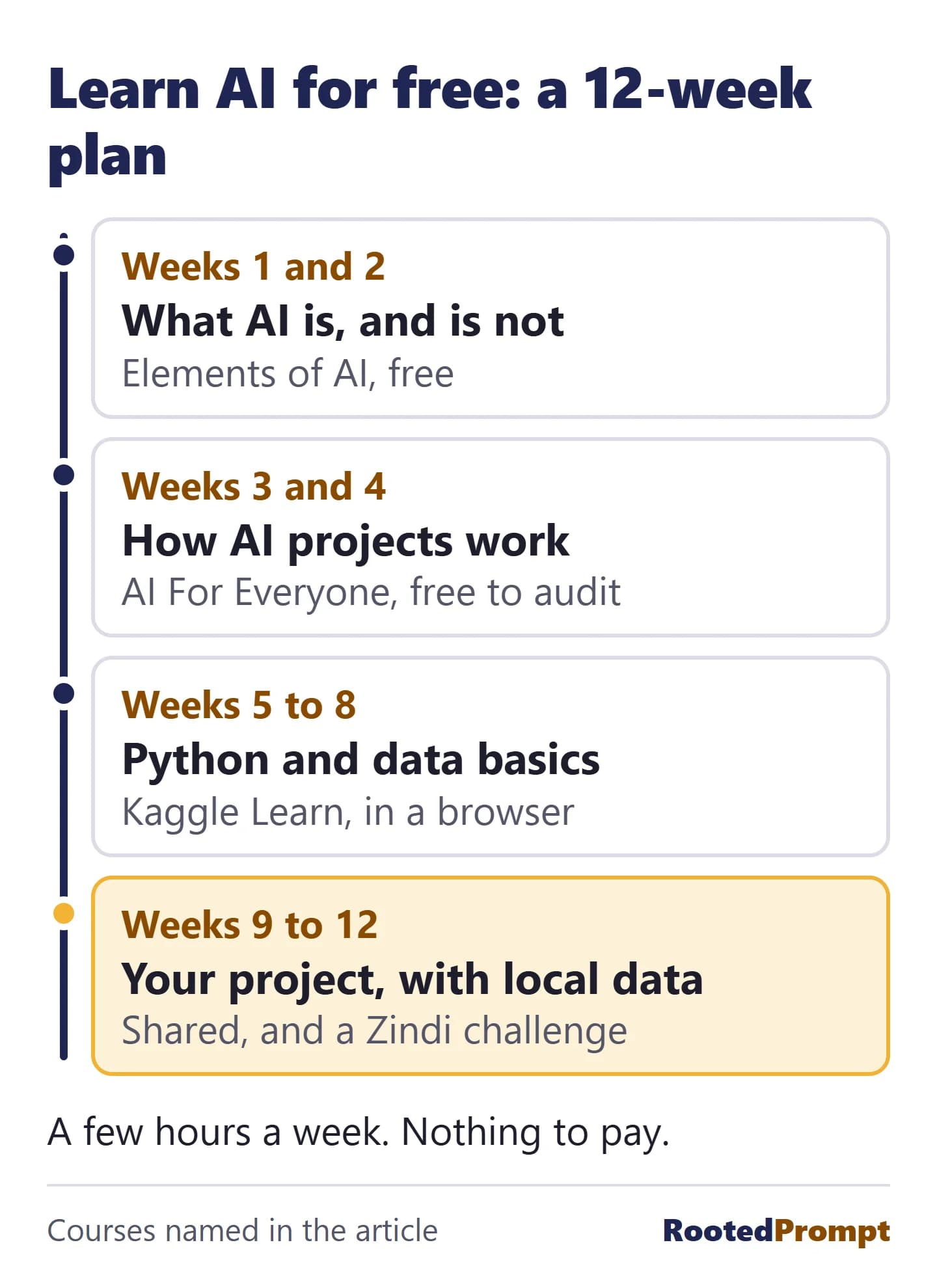
Weeks 1 and 2: what AI is, and is not
Start with Elements of AI, from the University of Helsinki and Reaktor. It explains what AI is and is not, with no maths and no code, it is free for anyone, and more than 2 million people have signed up for it. It is the best plain introduction to AI we know of.
Weeks 3 and 4: how AI projects work
Next, AI For Everyone by Andrew Ng on Coursera, free to audit. It explains how organisations choose and run AI projects, and where they fail. On many platforms the certificate costs money while the course itself is free to audit, so check before you start. If you want a certificate, choose it knowingly.
Weeks 5 to 8: Python and data
This is where building starts. Learn Python and how to clean, explore and chart data with free short courses such as Kaggle Learn, which run in your browser, so you do not need a powerful computer. Aim to be able to load a spreadsheet, tidy it, and draw a chart that answers a question.
Weeks 9 to 12: your own project, with local data
Build something small on data from where you live, write it up, and share it. Then try a challenge on Zindi, an AI challenge platform founded in Cape Town in 2018, which is free to join and sets problems from across Africa. More on the project below.
Steady beats intense. An hour every evening teaches more than a whole Saturday once a month.
Learning on a phone and a tight data budget
Most of this plan works on a phone. Download course videos when you are on Wi-Fi, and read the text versions where a course offers them, which use far less data. For the Python weeks a laptop helps, but free online notebooks such as Google Colab or Kaggle's run in a browser, so an ordinary computer at a library or a cyber café is enough.
Learn with others if you can. A study group of three or four, meeting for an hour a week in person or on WhatsApp with one agreed goal, keeps everyone going through the weeks when motivation drops. And keep a simple log of what you learnt each week. It becomes your evidence when you apply for anything.
Before you pay for an AI course
Paid courses are not all bad, and some are excellent. But the market for AI courses is crowded with offers that cost a month's income and promise a career in weeks, so it is worth asking a few questions before you pay.
- What will I be able to do at the end? A good course names it plainly: clean a dataset, train a simple model, build a working tool. Vague promises of "mastering AI" are a warning.
- Is there a project? If you finish with nothing you built yourself, you could have learnt the same from the free courses above.
- Who teaches it, and where are past students now? Ask to speak to two of them. A course that cannot connect you with anyone who finished it is telling you something.
- Does it promise a job? Nobody can promise that. Help with a portfolio, introductions and interview practice is worth something. A guarantee is not.
- Can you try it first? Many good courses offer a free first week or free materials. Take them, and pay only if the teaching suits you.
If a free course and a paid one teach the same thing, the free one plus a study group and a real project will usually take you further. Spend money, if you spend it at all, on what free courses cannot give: a teacher who reviews your work, or a programme that connects you to employers.
Communities and programmes on the continent
You do not have to learn alone, or from abroad. As of 9 October 2026, these are some of the places African learners grow.
Deep Learning Indaba has met every year since 2017, when the first gathering in Johannesburg brought together about 300 people from more than 30 African countries for lectures and practicals (Deep Learning Indaba). Smaller IndabaX events run in many countries. Masakhane, a volunteer research community working on African languages since 2019, has real projects where beginners and fluent speakers are both needed (Masakhane).
For those ready to go deep, the African Master's in Machine Intelligence (AMMI) at AIMS in Kigali launched in 2018 with support from Google and Facebook (AIMS AMMI). And governments run their own programmes: Nigeria's 3 Million Technical Talent (3MTT) includes AI and machine learning among its tracks (NITDA), and Kenya's Ajira Digital trains people for online and digital work (Kenya Year Book).
A first project that shows what you can do
Certificates show you finished a course. A project shows you can do the work, which is what employers and programmes are really looking for. It does not need to be large or clever. It needs real data, a clear question and an honest write-up.
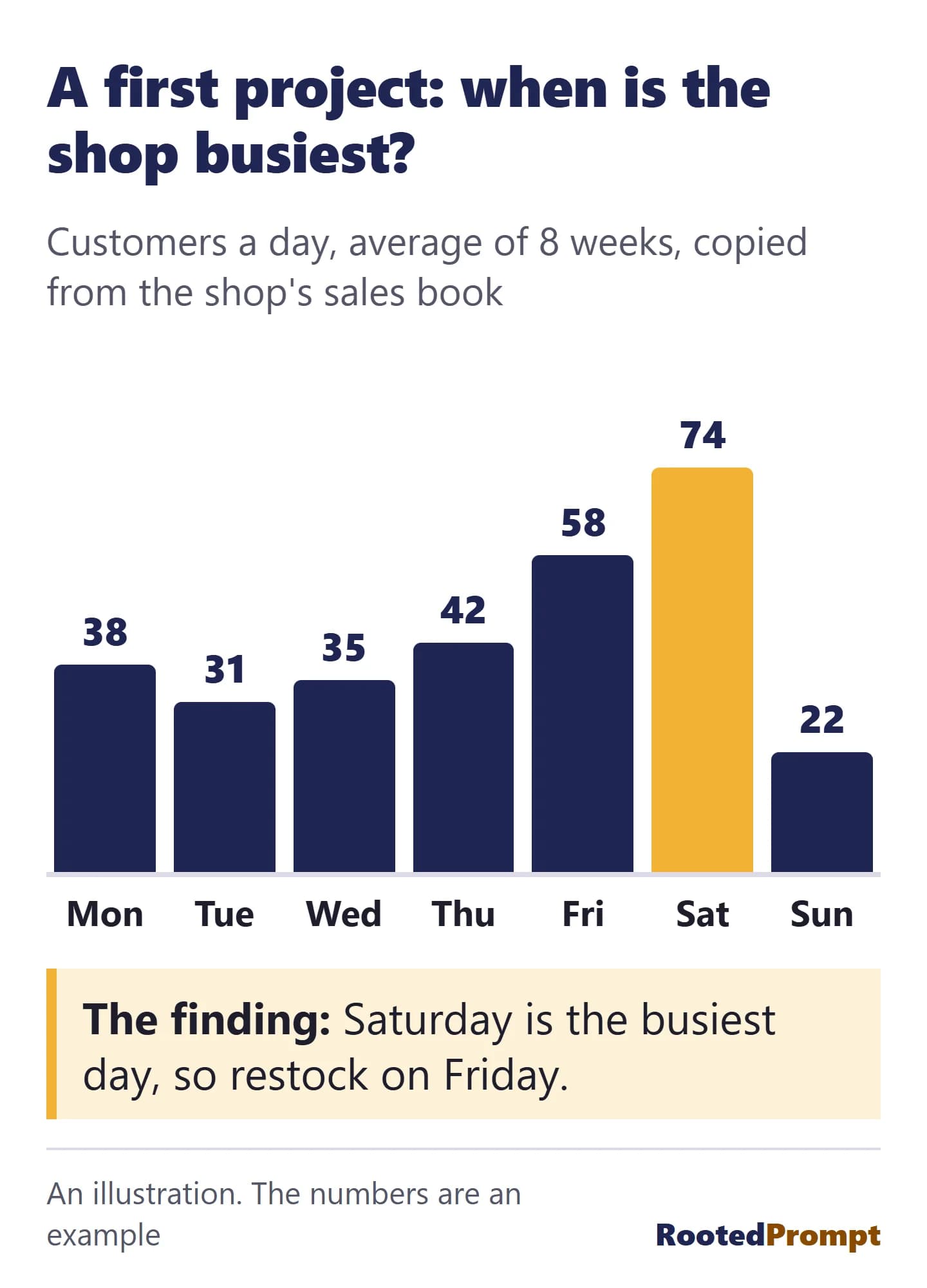
Ideas close to home work best. Daily sales from a family shop, cleaned and charted to show the busiest days, as above. Market prices of maize, beans or matooke over a few months, with a short note on what moved them. A few hundred sentences in your language, translated and checked by a fluent speaker, as a small dataset others can use, which, as our guide to why AI struggles with African languages explains, is exactly what the region lacks.
Write one page on what you did, what went wrong and what you would do next, and share it with a community above. If your data is about people, follow your country's data protection rules and ask for consent.
If you need income while you learn, AI training work can help, but read our guide to AI training jobs before you accept an offer.
Questions people ask
Yes. Elements of AI is free for anyone, AI For Everyone can be audited for free on Coursera, and Kaggle Learn teaches Python and data for free in a browser. What it costs is a few hours a week.
Some courses are free to take but charge for the certificate, so check before you start. A small project on real data, with a short write-up, shows employers far more than a certificate, and costs nothing.
Yes. Using AI well needs no degree. Building AI takes practice in programming and statistics, which free courses teach, though some roles, especially in research, ask for a degree.
The first four weeks can be done on a phone. For programming, a laptop helps, but free online notebooks such as Google Colab run in a browser, so an ordinary computer at a cyber café or library is enough.
Start online with the free courses above, then look for an IndabaX event or a university AI club near you, and follow local groups such as Sunbird AI in Uganda. Kenya's Ajira Digital programme trains people for online work.
Sources
- University of Helsinki and Reaktor, Elements of AI, read 9 October 2026.
- Coursera, AI For Everyone, read 9 October 2026.
- Kaggle, Learn Python, Data Viz, Pandas and More, read 9 October 2026.
- Zindi, About Zindi, read 9 October 2026.
- Deep Learning Indaba, Deep Learning Indaba 2017, 2017.
- AIMS AMMI, AIMS launches African Master's in Machine Intelligence in Kigali, Rwanda, 2018.
- Orife and others, Masakhane, Masakhane: Machine Translation for Africa, March 2020.
- NITDA, 3 Million Technical Talent (3MTT), read 9 October 2026.
- Kenya Year Book, Ajira Digital Programme, 23 May 2022.
Every figure above was checked against these sources on 9 October 2026. Found a mistake? Tell us through the Contact page, and we will correct it with the date.
Read next
AI training jobs in Kenya and Nigeria: the work, pay and risks
What the work really is, what has happened to workers here, and how to spot a scam.
Why AI struggles with African languages, and what data changes
Why AI is weaker in your language, and the people building the data to fix it.