AI training jobs in Kenya and Nigeria: the work, pay and risks
AI training jobs are paid online tasks that help build AI systems: labelling pictures, transcribing speech, rating AI answers and writing examples, often in your own language. They are real, many are done from Nairobi, Lagos, Kampala and Accra, and some pay in US dollars. They are also unstable gig work that a platform can end overnight, and fake offers that ask you to pay first are common. Take the work on your own terms, and use it to build skills that outlast any one platform.
By the RootedPrompt editorial team. Published 9 October 2026.
A recent graduate in Nairobi has been looking for work for eight months. One evening a message arrives from a number she does not know: a company is hiring "AI trainers" to work from home, at $25 an hour, no experience needed. All she has to do is pay a small fee to activate her account.
The message is almost certainly a scam. But the job it imitates is real, which is exactly why the scam works. Companies building AI systems do pay people, many of them in Kenya and Nigeria, to label data, transcribe speech, rate answers and write examples. "AI training jobs" is searched about 2,900 times a month in Kenya alone (Google Keyword Planner, read 9 October 2026), and behind each search is someone hoping the work is real.
It is real, and it can pay. It is also gig work with no guarantees, and the region has already seen pay that shocked readers abroad, a platform switched off overnight, and workers taking a global company to court. This guide sets out what the work is, what has happened to the people doing it, and how to take it on without being taken in.
What AI training and data annotation jobs involve
Every AI system learns from examples, and many of those examples are made or checked by people. That is the work. It comes in a few kinds, usually sold through task platforms or outsourcing companies.
Labelling, or data annotation. Drawing boxes around objects in photos, tagging what a sentence is about, marking whether a picture is safe. It needs care and consistency more than training.
Transcribing and recording. Typing what people say in a recording, or recording your own voice reading sentences, often in a local language. Here your language is an asset: as we explain in why AI struggles with African languages, good data in Swahili, Yoruba, Hausa or Zulu is scarce.
Rating and ranking. Reading two AI answers and choosing the better one, with a reason. This is often what "AI trainer" jobs mean.
Expert writing. Writing questions and model answers in a subject such as maths, law or medicine. These tasks usually ask for a degree or proven experience, and usually pay more.
Moderating. Reviewing violent, hateful or abusive material so that AI systems learn to block it. It is the hardest work of all, and it needs real protection.
What has happened to AI workers in the region
Three reported events, each documented by the press or the courts, show both the opportunity and the risks.
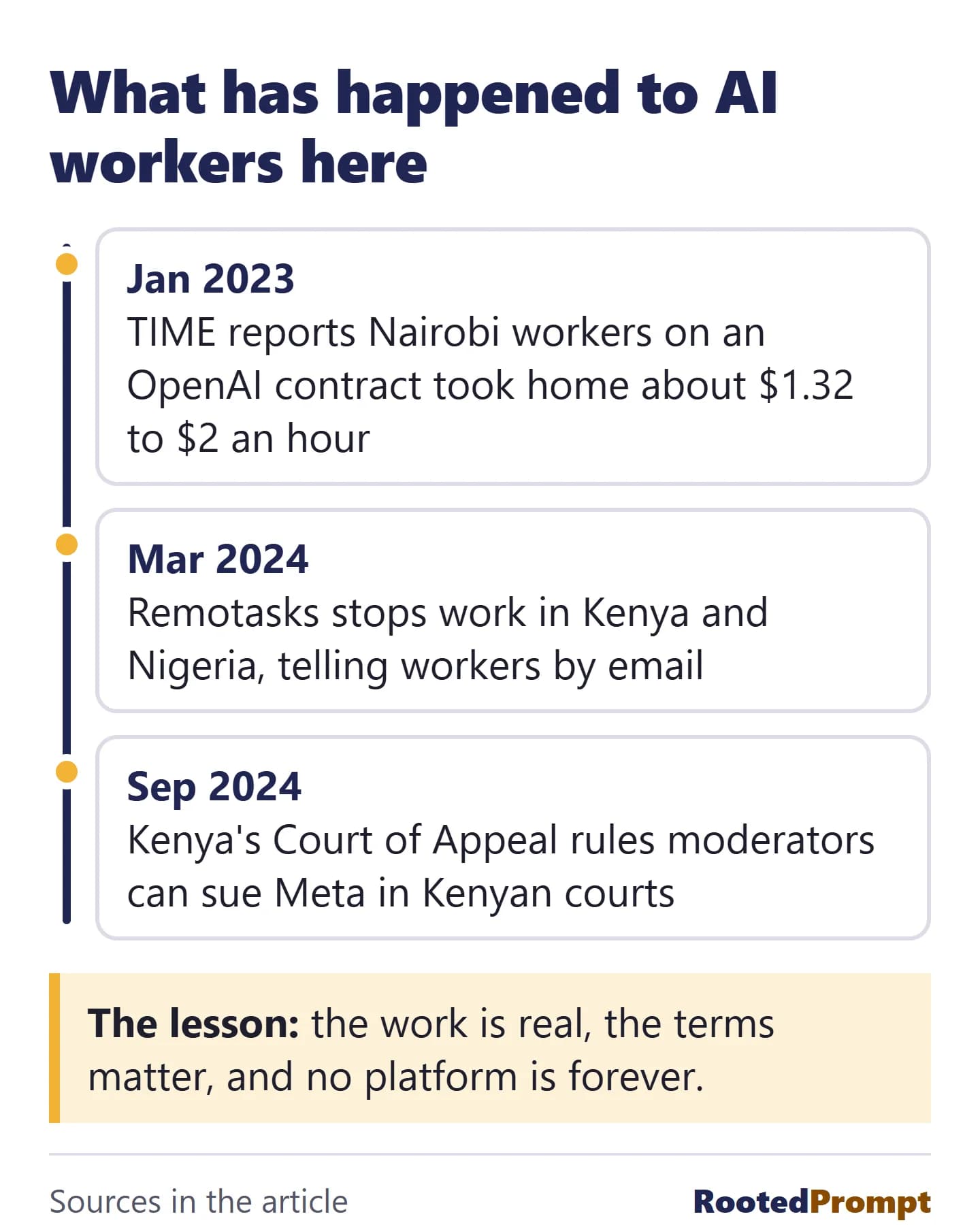
The pay. In January 2023 TIME reported that workers in Nairobi employed by Sama, an outsourcing company, labelled descriptions of violence and abuse for an OpenAI contract that began in November 2021, and took home between about US$1.32 and US$2 an hour depending on seniority. OpenAI said it offered wellness support, and Sama ended the contract in February 2022, earlier than planned (TIME, 18 January 2023).
The platform that closed. In March 2024 Remotasks, a task platform owned by Scale AI, stopped operating in Kenya, Nigeria and Pakistan. Kenyan workers were told by email that operations would end on 8 March 2024. The company said notices sent three weeks earlier had not reached workers in Kenya because of an error, and that completed work would be paid (Rest of World, 2024, Business Daily, March 2024).
The court case. In September 2024 Kenya's Court of Appeal ruled that Meta can be sued in Kenyan courts by content moderators who had worked through Sama, leaving the main claims to be heard (TechCabal, 21 September 2024).
None of this means every company treats workers badly. It means three practical things: get the terms in writing, never depend on one platform, and know that workers here have more legal standing than many assume.
How to spot a fake AI job
Back to the message on the graduate's phone. Real AI training work has become a perfect cover for scams, because the scammer can borrow its language and its promise of dollar pay. The fakes give themselves away in the same few ways.
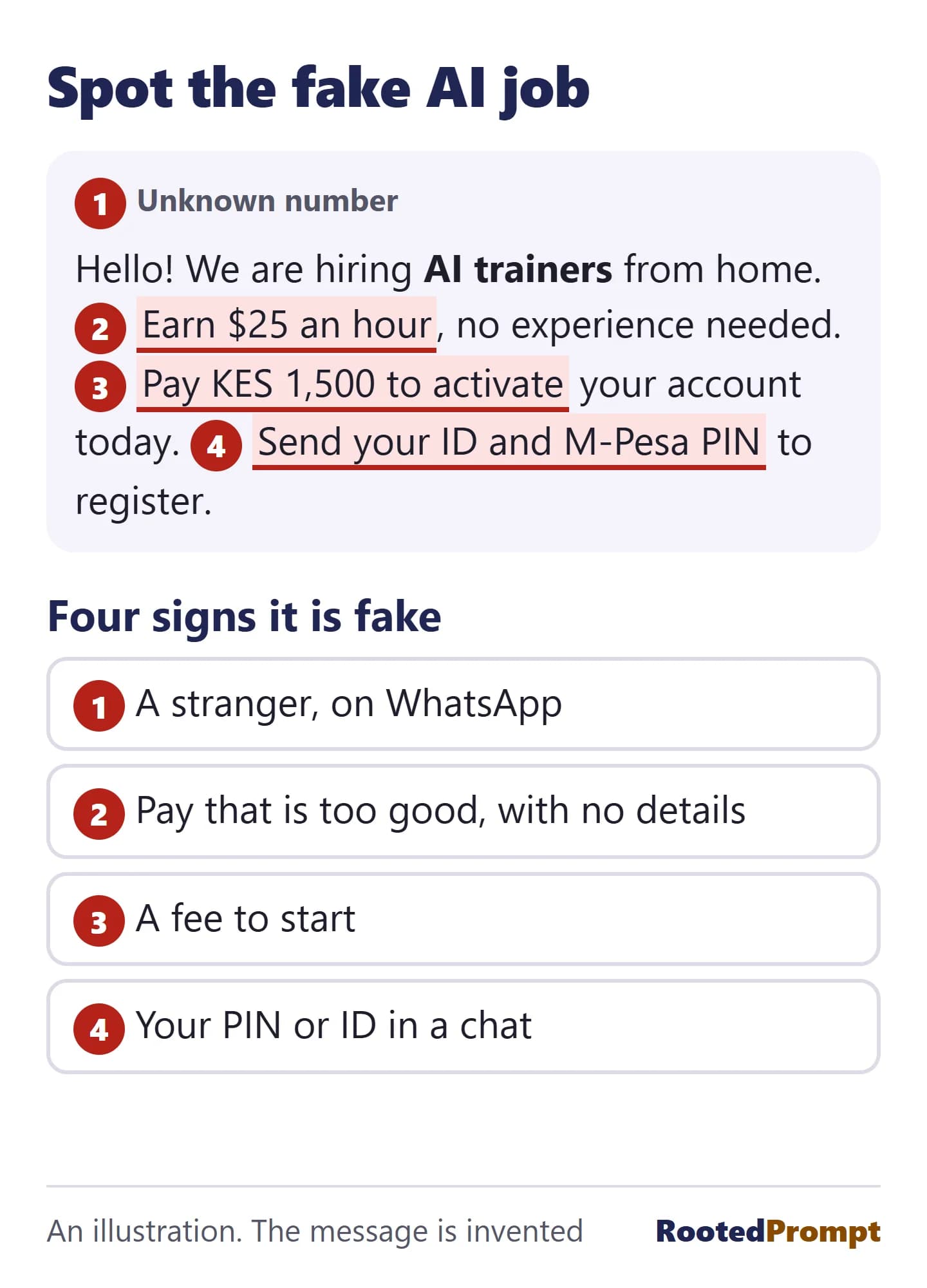
A fee to start is the surest sign. A real platform never asks for a "registration fee", a "training fee" or an "account activation" payment. A stranger on WhatsApp or Telegram is the next: find the company's own website yourself and apply there. Pay that is too good and too vague is the third. Real offers state the rate, the payment method, such as PayPal, Payoneer or a bank transfer, and the payment dates, in writing.
Your ID or mobile money PIN in a chat is the last. Identity checks happen on the company's own site, and nobody legitimate ever needs your PIN. If you are offered moderation work, add one more check: you should be able to skip disturbing content, and support should be offered.
A real AI job never asks you to pay to start.
Questions to ask before you accept
A real offer survives questions. Before you accept AI training work, from a platform or an outsourcing company, get answers to these, in writing where it matters.
- What exactly is the task? Ask to see an example. If it involves violent, sexual or abusive material, ask whether you can skip items and what support is offered.
- How am I paid? The rate per task or per hour, the currency, the method, and the dates. Ask what happens to work a reviewer rejects.
- Who is the employer? A platform, an outsourcing company or a client behind it? Find the company's own website and registration yourself.
- What happens if the work stops? Ask how completed work is paid if a project ends or the platform leaves your country, as Remotasks did in 2024.
- What do you need from me, and why? Identity checks are normal on an official site. A request for your mobile money PIN, a fee or your login details is not.
Keep the answers with your records. If anything changes later, you will know what you were promised, and so will anyone you ask for help.
Can you make money with AI this way?
Yes, as gig income, with its usual uncertainties. Rates vary by task, language, platform and month, and the best paid tasks go to people with scarce skills: fluent writing in a language the companies need, or real expertise in a subject. Treat it as income that can stop, not as a salary.
If you take the work, protect yourself. Keep copies of your contract, your task records and every payment, in case a platform closes or a payment is disputed. Spread your work across more than one platform. Check how your income is taxed where you live, since online income in US dollars is still income. And if a task affects your sleep or mood, stop and use the support offered. Your health is worth more than the rate.
Use the tasks to climb, not to stay
The most valuable thing AI training work can give you is not the hourly rate. It is evidence of skills that lead to better work, inside the AI industry or outside it.
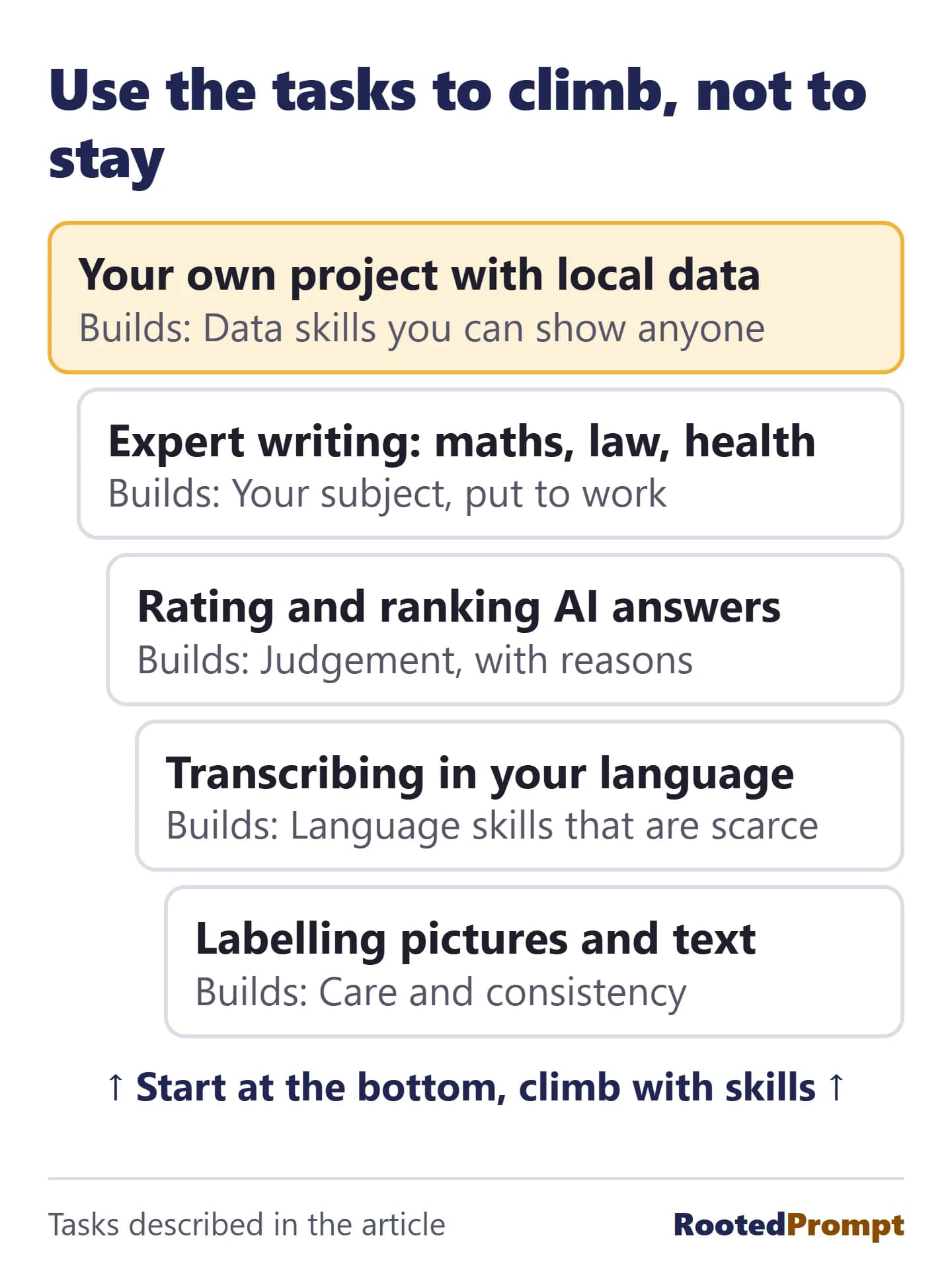
Governments in the region are building the same ladder. Kenya's Ajira Digital programme, run by the Ministry of ICT since 2016, trains young people for online and freelance work and links them to digital jobs (Kenya Year Book). Nigeria's 3 Million Technical Talent programme, 3MTT, trains people in data, AI and software skills, aiming at three million trained by 2027, and its first fellows started in December 2023 (World Economic Forum, September 2024). Kenya's National AI Strategy 2025 to 2030 names skills and talent as a priority (Citizen Digital).
You do not have to wait for a programme. Our guide to learning AI for free sets out a twelve-week plan that ends with a project of your own, the top rung of that ladder.
Questions people ask
Yes. Companies pay people to label data, transcribe, rate answers and write examples. Many offers seen on WhatsApp and social media are fake, especially any that ask you to pay first.
It varies by task, language and platform, and rates change often. TIME reported in 2023 that one harmful-content labelling contract paid workers in Nairobi about US$1.32 to US$2 an hour. Specialist writing work usually pays more. Always get the rate in writing.
Remotasks ended operations in Kenya, Nigeria and Pakistan in March 2024. Its owner, Scale AI, said it would pay for completed work. Workers in Kenya were told by email that operations would end on 8 March 2024.
Not for most labelling, transcription and rating tasks, which need care, good language skills and a reliable connection. Expert tasks in maths, science, law or medicine usually ask for a degree or proven experience.
Sources
- TIME, OpenAI used Kenyan workers on less than $2 per hour: exclusive, 18 January 2023.
- Rest of World, Scale AI's Remotasks is booting workers with no explanation, 2024.
- Business Daily, Online gig site Remotasks exits Kenya, March 2024.
- TechCabal, Meta's ex-content moderators seek $1.6 billion in compensation in Kenya, 21 September 2024.
- Kenya Year Book, Ajira Digital Programme, 23 May 2022.
- World Economic Forum, Nigeria seeks digital transformation for a stronger economy, September 2024.
- Citizen Digital, Kenya launches National AI strategy, 27 March 2025.
Every figure above was checked against these sources on 9 October 2026. Found a mistake? Tell us through the Contact page, and we will correct it with the date.
Read next
How to learn AI for free in Africa: a 12-week plan
Free courses, African communities, and a plan that ends with your own project.
Why AI struggles with African languages, and what data changes
Why AI is weaker in your language, and the people building the data to fix it.