Why AI struggles with African languages, and what data changes
AI language tools learn from huge amounts of text and recorded speech, and most of what they have seen is in English and a few other world languages. That is why AI translation and voice tools are weaker in Luganda, Hausa or Kinyarwanda, and can cost more to use in them. The fix is local data collected properly, and African researchers and communities are already building it. Until then, treat any machine translation as a first draft for a fluent speaker to check.
By the RootedPrompt editorial team. Published 9 October 2026.
A community health worker in Gulu needs a notice about a vaccination day, in Acholi, for the noticeboard by Friday. She types the English into an AI chat and asks for a translation. What comes back looks like Acholi. A colleague who grew up speaking it reads it and laughs at one sentence, frowns at another, and points out that the date has changed.
Most people who have tried AI translation in an African language know this feeling. The same tools that write fluent English stumble in Luganda, Yoruba, Dholuo or Kinyarwanda. It is tempting to conclude that these languages are somehow hard for computers.
They are not. An AI system can only learn a language from examples, and for most African languages the examples are thin. That is a problem of data, which means it can be fixed, and across the region people are fixing it. This guide explains why the gap exists, who is closing it, and how to use AI in your language safely in the meantime.
Why AI translation is weaker in your language
Africa has more than 2,000 languages (Masakhane, 2020). Many are spoken by millions of people but written online far less than English, and much of what is online is religious text or news translated from English. A model trained on the web therefore sees billions of English sentences for every few thousand in Acholi, and its Acholi is correspondingly weak.
Volume is only part of it. Raw text becomes good training data when fluent speakers label, check and correct it, and that work has been done for far fewer African languages. Speech is harder still: voice tools need hours of recorded speech from many speakers, and people in Kampala or Lagos often mix two or three languages in one sentence, which tools trained mostly on single-language speech handle badly.
There is a cost too. AI tools read text in pieces called tokens, and most were designed around English. Researchers at Oxford found that the same text can take up to 15 times as many tokens in some languages as in English (Petrov and others, NeurIPS 2023). More tokens means slower answers, less room for context, and a bigger bill for anyone paying by the token.
Training data. The text, images, speech and numbers an AI system learns from. What is missing from it, the system cannot do well. That is as true of crops, prices, health and law as it is of language.
Who is building the data and the models
The encouraging part is who is doing the fixing. Much of the work is African-led, and much of it is open for anyone to use. As of 9 October 2026, these are among the most important efforts.
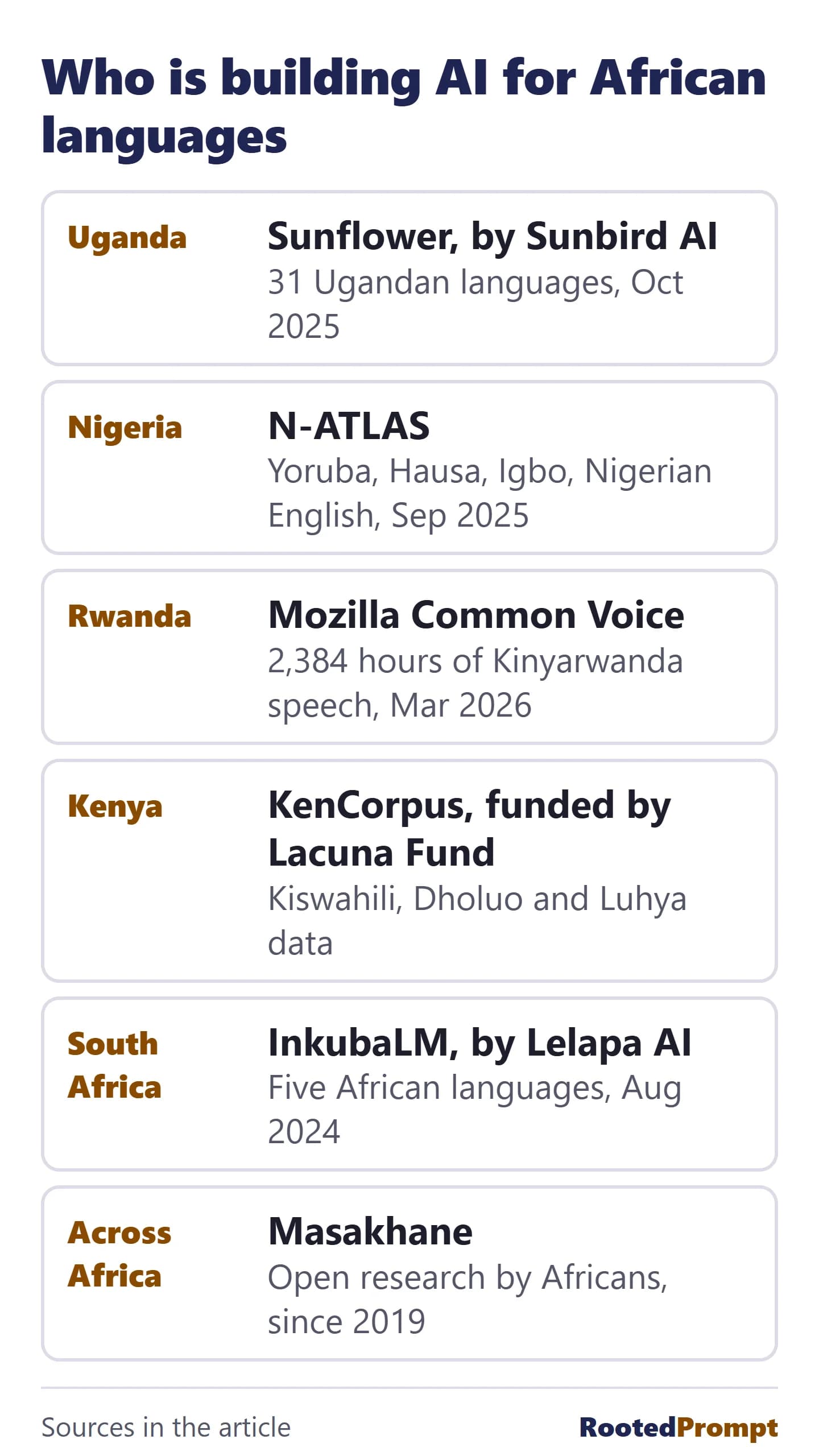
Uganda: Sunflower
Sunbird AI, a Kampala non-profit working with the Ministry of ICT and National Guidance, launched its Sunflower models in October 2025. They translate and chat in English and 31 Ugandan languages, including Luganda, Acholi, Ateso, Lugbara and Runyankole (Sunbird AI, Sunflower paper, October 2025). Sunbird itself warns that quality varies by language and that the models are not for medical or legal use without human review.
Nigeria: N-ATLAS
In September 2025 Nigeria's National Centre for Artificial Intelligence and Robotics, with Awarri Technologies, launched N-ATLAS, an open model for Yoruba, Hausa, Igbo and Nigerian-accented English, built from voices recorded by thousands of Nigerians (TechCabal, 26 September 2025).
Rwanda: a nation of voice donors
On Mozilla Common Voice, where volunteers record and check sentences, Kinyarwanda had about 2,384 hours of recorded speech from 1,181 speakers by version 25 in March 2026, one of the platform's largest languages (Mozilla Foundation).
Kenya, South Africa and the continent
In Kenya, the KenCorpus team from Maseno University, the University of Nairobi and Africa Nazarene University built text and speech data for Kiswahili, Dholuo and Luhya with funding from Lacuna Fund (Lacuna Fund). In South Africa, Lelapa AI released InkubaLM in August 2024, a small open model for Swahili, Yoruba, isiXhosa, Hausa and isiZulu (Africa World Initiative, Princeton University). And since 2019 Masakhane, a volunteer research community, has done open translation and language research for African languages, led by Africans (Masakhane, 2020).
Large companies have moved too. In May 2022 Google Translate added Luganda, Twi, Ewe, Lingala, Krio and five other African languages (The Star, 12 May 2022).
Most performance claims for these models come from the teams that built them. Sunbird's plain warning about its own limits is a good sign, and a good model for everyone: test any tool in your own language before you rely on it.
Africa's languages are not hard for AI. Their data is thin, and that can be fixed.
Using AI translation in your language today
Back in Gulu, the health worker does not need to give up on AI. She needs to use it as a first draft and keep the checking in human hands. The picture shows the order that works.
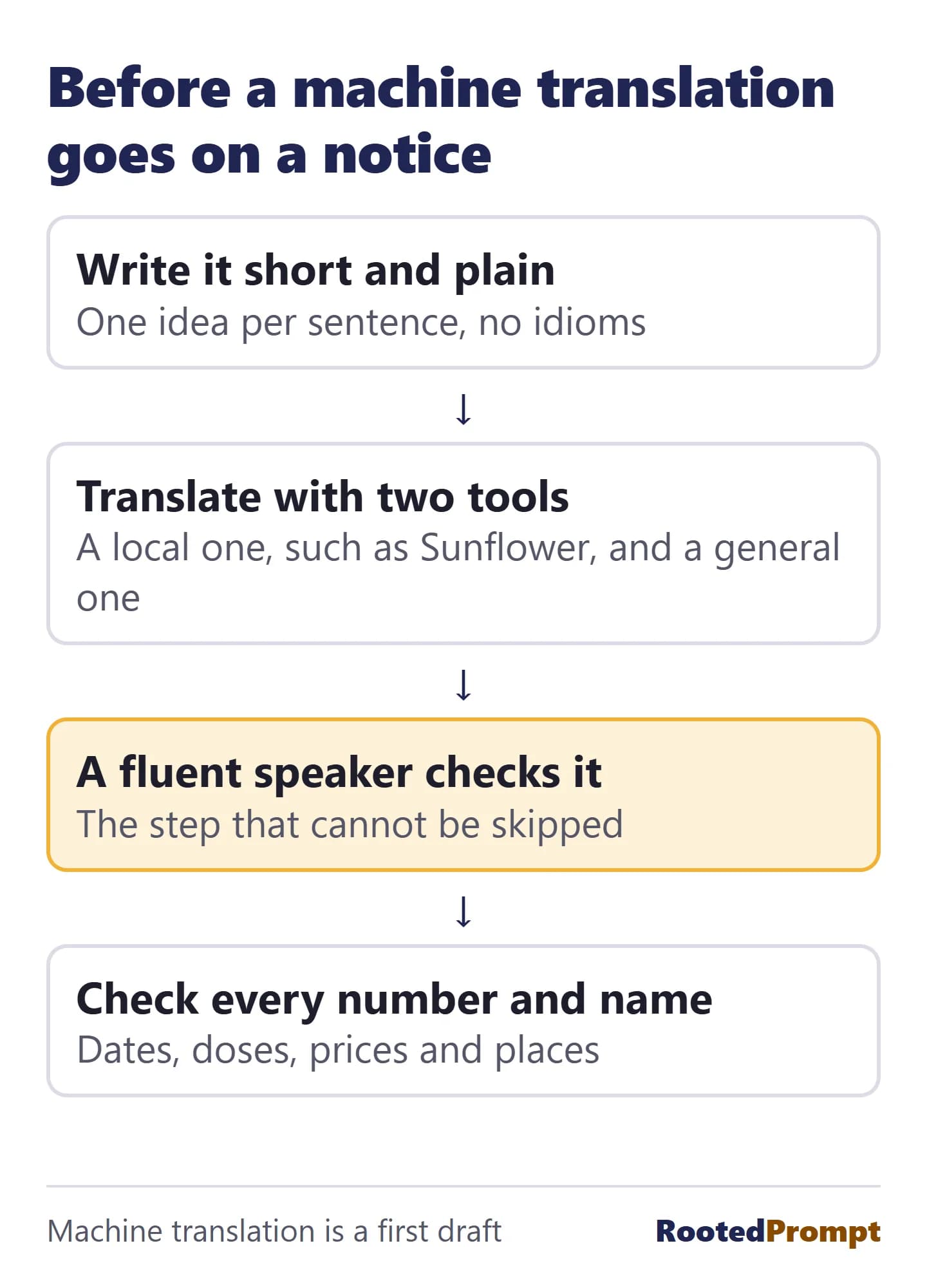
Write the English short and plain first. One idea per sentence, with no idioms, translates far more reliably than a long sentence full of expressions. Then try two tools on the same text: for Ugandan languages, Sunbird's translation, and for Yoruba, Hausa and Igbo, tools built on N-ATLAS, alongside a general assistant or Google Translate. Where they agree, you can be more confident. Where they differ, you know where to look.
Then a fluent speaker reads it, and nothing public skips that step. A wrong word on a health notice, a price list or a contract can do real harm. Finally, check every number, date, dose, name and place against the original, because translation tools sometimes change or drop them, as the Gulu notice showed.
The same applies to AI voice and text to speech, which are newer and patchier still in African languages. A voice that mispronounces a name or a place can confuse listeners more than plain text would, so have a speaker listen before you publish audio.
How you can help your language
The scarcest ingredient in all of this is fluent speakers' time, which means anyone reading this can help. On Mozilla Common Voice, you can record or check sentences in many African languages in a few minutes on a phone. Masakhane welcomes researchers and fluent speakers, and universities and local groups often need people to translate and check sentences.
If you collect language data yourself, do it properly: ask for clear consent, explain how recordings will be used, pay people fairly for their time, and follow your country's data protection law, which our guide to data protection laws and AI sets out. Data collected well is data that can be shared, and shared data is what closed the gap for English in the first place.
And if you want to go further than contributing, our guide to learning AI for free ends with a project built on local data.
Questions people ask
Large assistants understand and write Swahili reasonably well, because more Swahili text exists online than for most African languages. They still make mistakes with idioms, names and local terms, so check anything important with a fluent speaker.
Google Translate added Luganda in May 2022, and Sunbird AI's Sunflower models, launched in October 2025, cover Luganda and 30 other Ugandan languages. Test them on your own sentences before relying on them.
It depends on the language and the text, and it changes as the tools are updated. Translate the same short passage with two or three tools, including a local one where it exists, and ask a fluent speaker which is closest.
Many AI tools charge by the token, a piece of a word, and their tokenizers were designed mostly around English. Research presented at NeurIPS 2023 found the same text can need up to 15 times as many tokens in some languages.
Record or check sentences on Mozilla Common Voice, join Masakhane or a local university project, and help check translations. Fluent speakers are the scarcest part of this work.
Sources
- Orife and others, Masakhane, Masakhane: Machine Translation for Africa, March 2020.
- Petrov, La Malfa, Torr and Bibi, NeurIPS 2023, Language Model Tokenizers Introduce Unfairness Between Languages, 2023.
- Sunbird AI, Sunflower models for Ugandan languages, read 9 October 2026.
- Sunbird AI, Sunflower: A New Approach To Expanding Coverage of African Languages in Large Language Models, October 2025.
- TechCabal, Nigeria wants an AI that speaks like its people, but can it deliver?, 26 September 2025.
- Mozilla Foundation, Common Voice Scripted Speech 25.0, Kinyarwanda, March 2026.
- Lacuna Fund, Sharing new Lacuna-funded text and speech data resources for selected languages in Kenya, read 9 October 2026.
- Africa World Initiative, Princeton University, Lelapa AI launches Africa's first AI large language model, 5 August 2024.
- The Star (Kenya), Google Translate adds 24 new languages, 12 May 2022.
Every figure above was checked against these sources on 9 October 2026. Found a mistake? Tell us through the Contact page, and we will correct it with the date.
Read next
Data protection laws and AI in Kenya, Uganda, Nigeria and beyond
Seven countries' data protection acts, who must register, and what they mean for your AI use.
How to learn AI for free in Africa: a 12-week plan
Free courses, African communities, and a plan that ends with your own project.