Is it the work of AI? How things are really made today
"That is the work of AI" is now said of almost anything polished, and it is usually wrong. Most things made today were made by people who decided what to make, used AI as one tool among several, and chose what to keep. The questions that matter are not "was AI used?" but who decided what it says, who checked it, and who answers for it if it is wrong.
By the RootedPrompt editorial team. Published 9 October 2026.
Listen for it this week and you will hear it everywhere. A sharp poster for a church event, a song with a clean sound, a photo that looks too good for a phone: "that is the work of AI". It is said as a compliment to the tool, a dismissal of the person, or both.
Most of the time it is simply wrong about how the thing was made. And the mistake is not harmless. It takes credit from people who did real work, and, more dangerously, it hides the part of the work that decides whether you can trust the result: whether anyone checked.
This guide argues for a better habit. Instead of asking whether AI was used, ask three questions about the people behind the work. A real case from South Africa in 2026 shows why they matter more than the tool.
What "the work of AI" usually hides
Look at how the three things above are usually made. In each case AI, or software that may include it, did something. In none of them did "AI make it" in the way people mean.
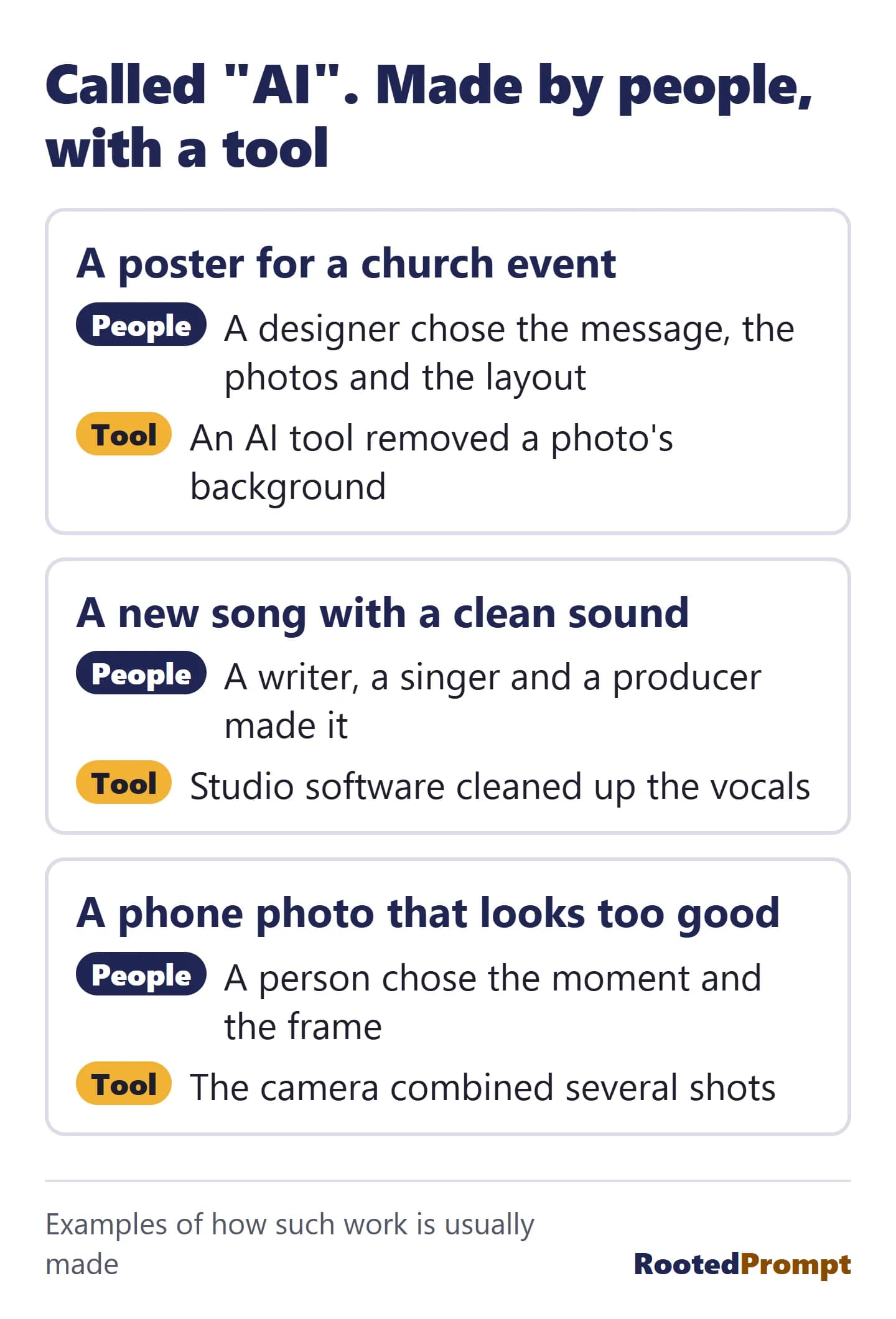
The designer started from a template, perhaps, and let a tool cut a photo from its background. But the message, the choice of photos and the layout were decisions. The producer used software to clean up a vocal, as studios have done for years, but the song was written and sung. And most phone cameras now combine several exposures automatically, which is computing inside the camera, while the person holding it chose the moment.
Saying "AI made it" erases those decisions. For a young designer, musician or writer competing for clients in Kampala, Nairobi or Lagos, that is not a small thing. A careless label can lower the price they can ask, or lose them the job.
A real case: the policy with references nobody checked
On 10 April 2026 South Africa's Department of Communications and Digital Technologies published a draft National AI Policy for public comment (Afriwise, 15 April 2026). Its reference list cited academic journal articles that did not exist. The news site News24 reported it, and Connecting Africa counted at least six fabricated references in the bibliography (Connecting Africa, 28 April 2026).
On Sunday 26 April the Minister, Solly Malatsi, withdrew the whole draft. "The most plausible explanation is that AI-generated citations were included without proper verification," he wrote, adding that the failure "has compromised the integrity and credibility of the draft policy" and that "vigilant human oversight over the use of artificial intelligence is critical" (Engineering News, 28 April 2026). He promised consequences for those responsible for drafting and quality assurance.
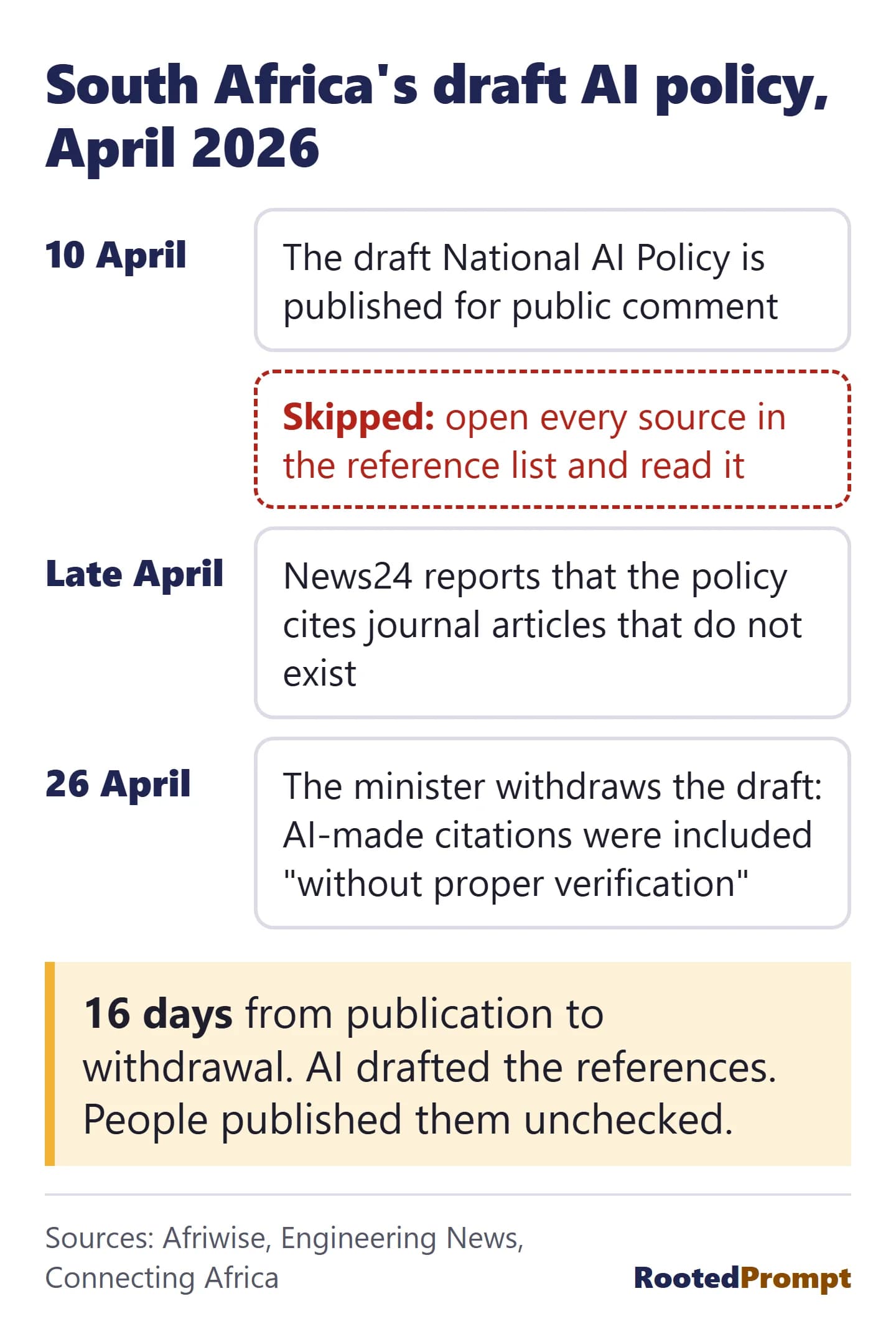
Look closely at what failed. The AI tool did what such tools often do when asked for references: it produced ones that looked right, with plausible authors, titles and journals. The step that was skipped was a human one, and a simple one: open each source and read it. Calling this "the work of AI" gets it exactly backwards. AI drafted. People published without checking.
The minister's response is also worth copying. He withdrew the work, said plainly what had gone wrong, and named the process that had failed. Any business, school, church or newsroom using AI can adopt the same rule: nothing goes out until a named person has checked it.
AI drafted the references. People published them without checking.
Is AI good or bad? The wrong question
Ask most people about AI and the conversation turns quickly to whether it is good or bad. The South African case shows why that question does not get far. The same tool that invented those references also helps millions of people draft letters, translate notices and learn new skills every day. The tool did not decide to publish. People did.
A better question is about the work in front of you, not about AI in general. Was this made in a way you can trust? That depends on the people behind it, and on three things you can check.
Three questions to ask instead of "is it AI?"
- Who decided what it says? A real author or organisation should be named, even if AI helped.
- Who checked it? Facts, figures, names and references should have been checked by a person against the original sources.
- Who answers for it? There should be a way to report a mistake and see it corrected, with a date.
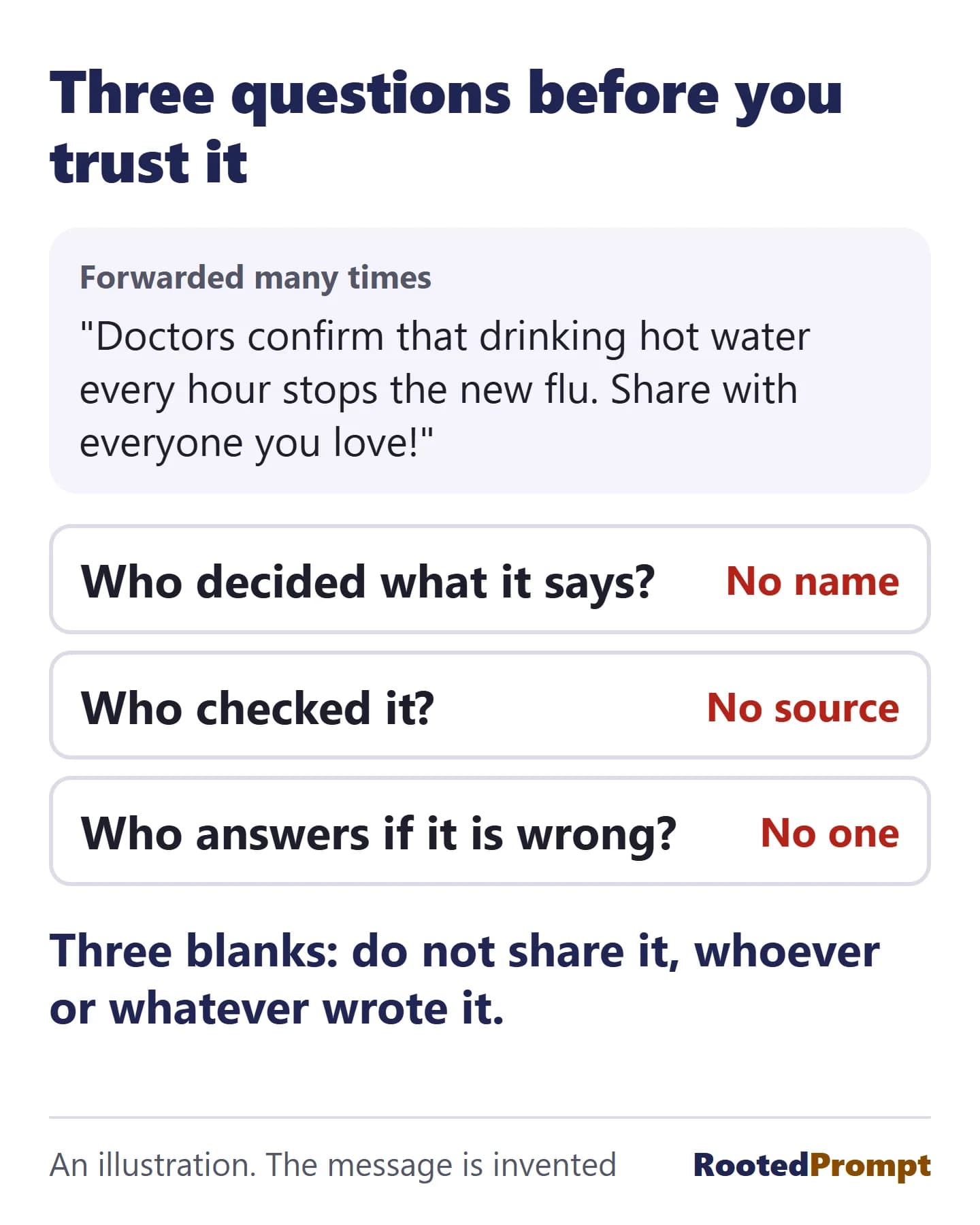
If all three have answers, how much AI was used matters far less. If none do, be careful, whether or not AI was involved. These questions also work where AI detectors fail: a detector guesses from style, and its guesses are often wrong, while the three questions ask for things that either exist or do not.
They apply to your own work too. If you use AI to draft a proposal, a report or a post, keep the human steps: decide what it should say, check every fact against its source, and put your name to it.
If you use AI in your own work
The three questions are not only for judging other people's work. They are the simplest standard for your own. If you draft a proposal, a sermon, a report or a social media post with AI, the questions tell you what you still owe the people who will read it.
Decide first. Know what you want to say before you ask a tool to help you say it. A tool asked to "write something about our new product" will write something. It may not be what you believe or can promise.
Check everything that states a fact. Names, numbers, dates, quotations and references are where AI tools most often invent. Open each source and read the part you rely on, the step South Africa's drafters skipped.
Put your name to it. If you would not be comfortable answering for every sentence, it is not ready.
Whether to say that you used AI depends on where the work goes. Many schools, employers, clients and platforms now have rules, and some ask for a short note such as "drafted with AI and edited by me". Where there is no rule, a plain word in the right place builds trust without making the tool the story. We explain our own practice on How we write.
Where governments in the region stand
Governments are beginning to write down who is accountable when AI is used, mostly through national strategies. As of 9 October 2026:
Rwanda approved a National AI Policy, with ethical guidelines, on 20 April 2023 (Access Partnership). Kenya launched its National AI Strategy 2025 to 2030 on 27 March 2025, with governance and ethics among its pillars (Citizen Digital). Nigeria's communications ministry released a National AI Strategy on 19 September 2025 (Digital Policy Alert). Ghana launched its National AI Strategy 2025 to 2035 on 24 April 2026 (Ghana News Agency).
South Africa is back at the drafting stage after the withdrawal, and Uganda's ICT ministry said in April 2026 that its AI strategy was being drafted (Daily Monitor, 1 April 2026). Our guide to data protection laws and AI covers the laws that already protect people when AI handles their data.
Questions people ask
Not by itself. It depends on the rules of your school, employer or client, and on whether you say how you used it. Hiding AI use, or handing in work you cannot explain or stand behind, is the problem.
It is a tool, and the same tool can help or harm depending on how people use it and whether they check its output. Judge the work in front of you by who made it, who checked it and who answers for it.
Because its reference list cited journal articles that did not exist. The minister said the most plausible explanation was AI-generated citations included without proper verification, and withdrew the draft on 26 April 2026.
Keep drafts, notes, source files and version history, and be ready to explain your choices. People who did the work can show how they did it.
Sources
- Afriwise (Werksmans Attorneys), Speak Now or Forever Hold Your Peace. The Draft AI Policy Has Been Published and Parties Have 60 Days to Comment, 15 April 2026.
- Engineering News (Creamer Media), South Africa withdraws AI policy due to fake AI-generated sources, 28 April 2026.
- Connecting Africa, SA withdraws AI policy after 'fictitious sources' scandal, 28 April 2026.
- Access Partnership, Rwandan government approves National AI Policy, April 2023.
- Citizen Digital, Kenya launches National AI strategy, 27 March 2025.
- Digital Policy Alert, Nigeria: Federal Ministry of Communication, Innovation and Digital Economy released National Artificial Intelligence Strategy, 19 September 2025.
- Ghana News Agency, Ghana to invest $250m in AI Centre, launch national strategy, 25 April 2026.
- Daily Monitor, Govt AI strategy will be ready by June, says ICT ministry, 1 April 2026.
Every figure above was checked against these sources on 9 October 2026. Found a mistake? Tell us through the Contact page, and we will correct it with the date.
Read next
Do AI detectors work? How to tell if AI made it
Why an AI detector score is a guess, who it wrongs, and the checks that work better.
Can AI build a website or app for you?
A prompt gets you a draft. What turns it into something customers can rely on.