Do AI detectors work? How to tell if AI made it
An AI detector estimates whether text or a picture was made by AI, and for text that estimate is often wrong. OpenAI withdrew its own text detector in 2023 for low accuracy, and a Stanford study found detectors labelled most essays by non-native English writers as AI-written. Treat any score as a hint, never as proof. The stronger evidence is the work itself: drafts, version history, sources, and the person explaining what they did.
By the RootedPrompt editorial team. Published 9 October 2026.
Imagine a second-year student at a university in Accra. She writes her essay over a week, in careful, plain English, which is her second language after Twi. Her lecturer pastes it into a free AI detector, and the screen says 87% AI. She is called in to explain why she cheated.
Scenes like this are why "ai detector" is one of the most searched phrases about AI in the region: about 22,200 searches a month in Kenya and the same in Nigeria, and 9,900 in Ghana (Google Keyword Planner, read 9 October 2026). Students search to check their own work before handing it in. Teachers and employers search for a tool that will settle the question for them.
No detector can settle it. A detector does not see who wrote something, or how. It measures the style of the words and guesses, and its guesses go wrong most often for exactly the people in her position. This guide explains why, and what to ask for instead, for text and for pictures.
How an AI text detector decides
Most AI text detectors work by measuring how predictable the words are. Text written by an AI model tends to use the most likely word at each step, so it reads smoothly and evenly. A detector scores a piece of writing by how often it took the likely path, and calls the most predictable writing "AI".
The trouble is that predictable is not the same as machine-made. Plain words in common patterns are also what good teachers ask for, what careful writers in a second or third language produce, and what technical and legal writing looks like. The score measures a style, and many people write in that style.
The clearest evidence comes from the company that made ChatGPT. In January 2023 OpenAI released its own tool to tell AI writing from human writing. On its own test it caught 26% of AI-written text, and wrongly called 9% of human writing AI. On 20 July 2023 it switched the tool off, citing its low accuracy (OpenAI). If the maker of the best-known AI writer could not build a reliable detector for it, a free tool on the web deserves at least as much caution.
Why detectors wrong second-language writers
In 2023 researchers at Stanford put this to the test. They ran seven widely used detectors on 91 essays written by non-native English speakers for the TOEFL English exam, and on 88 essays by US eighth-grade pupils. The detectors classified the pupils' essays correctly. They labelled the TOEFL essays AI-written 61.3% of the time on average, and all seven agreed on a wrong verdict for almost one essay in five (Liang and others, Patterns, July 2023).
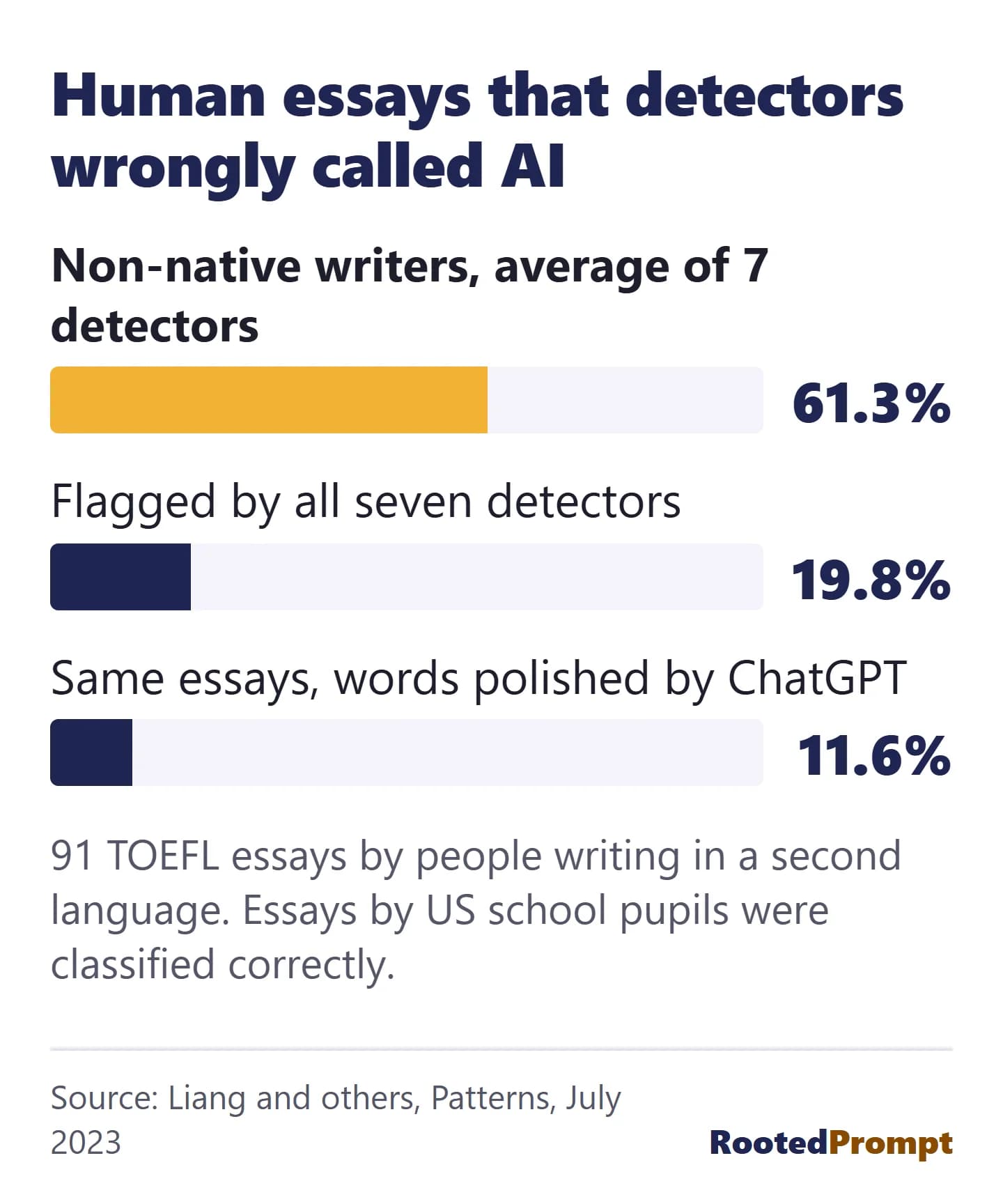
Then the researchers did something revealing. They asked ChatGPT to make the same essays sound more like a native speaker, with richer vocabulary. The wrong verdicts fell from 61.3% to 11.6%. In other words, the easiest way to pass an AI detector was to use AI to dress up the words, and the surest way to fail one was to write plainly in a second language.
That matters directly here. Across Uganda, Kenya, Nigeria, Ghana, Tanzania and Rwanda, millions of people study and work in English as a second language, and they are taught to write clearly and simply. Detector makers say their newer versions are fairer, and some may be. But none publishes error rates for writers from this region, so nobody can say how often a score is wrong for a student in Accra, Kampala or Lagos.
The easiest way to pass an AI detector was to use AI to dress up the words.
A score is not evidence. Here is what is
If a score cannot show who wrote something, what can? The same things that would settle any question of authorship before AI existed: the trail the work leaves behind, and the person who did it.
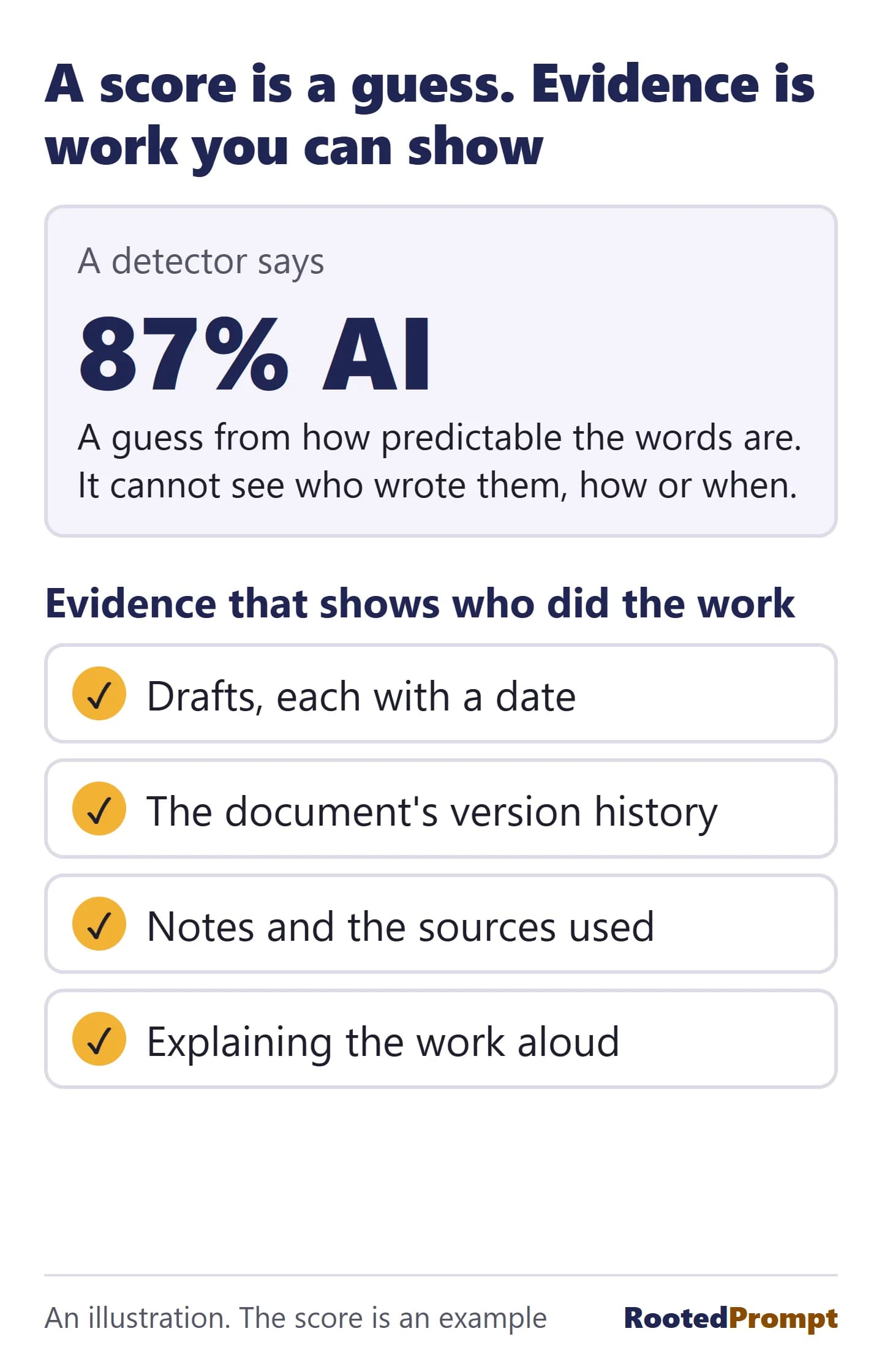
For teachers and employers. Ask for drafts and notes, and the sources the work drew on. Ask the person to talk you through the work: why they chose this argument, what they cut, what a difficult sentence means. People who did the work can do this easily, and it takes ten minutes. A detector score can be the reason to have that conversation. It should never be the verdict.
For students and writers. Work in a tool that keeps a version history, such as Google Docs or Microsoft Word, and keep your notes and drafts until your work is marked. If you are accused, ask which tool made the finding and what its known error rate is, offer to explain your work in person, and point to the research above. Detectors are known to wrongly flag second-language writers, and saying so is not an excuse. It is the evidence.
Using AI is not the same as cheating, either. Many universities and employers now allow AI for some tasks, if you say how you used it. Read the rules where you are and be plain about what you did. This site does the same on How we write.
Is this AI generated? Checking photos and video
For pictures, an "AI image detector" faces the same limits as a text detector: it guesses from what the image looks like. Two newer signals are stronger, because they record how a file was made rather than guessing from its style.
Invisible watermarks. Google marks images made by its own AI tools with SynthID, a watermark hidden in the pixels that survives resizing and compression, and you can ask the Gemini app whether an image carries it. But only images from tools that use SynthID will ever carry it, so a missing watermark proves nothing.
Signed records. The C2PA standard, used by some camera makers, editing software and AI tools, attaches a signed record to a file showing what made and changed it. You can read one at contentcredentials.org/verify. A screenshot or a re-saved copy usually strips the record, so its absence proves nothing either.
In practice, a picture forwarded on WhatsApp has usually lost both. That is why the oldest checks are still the most useful, in this order.
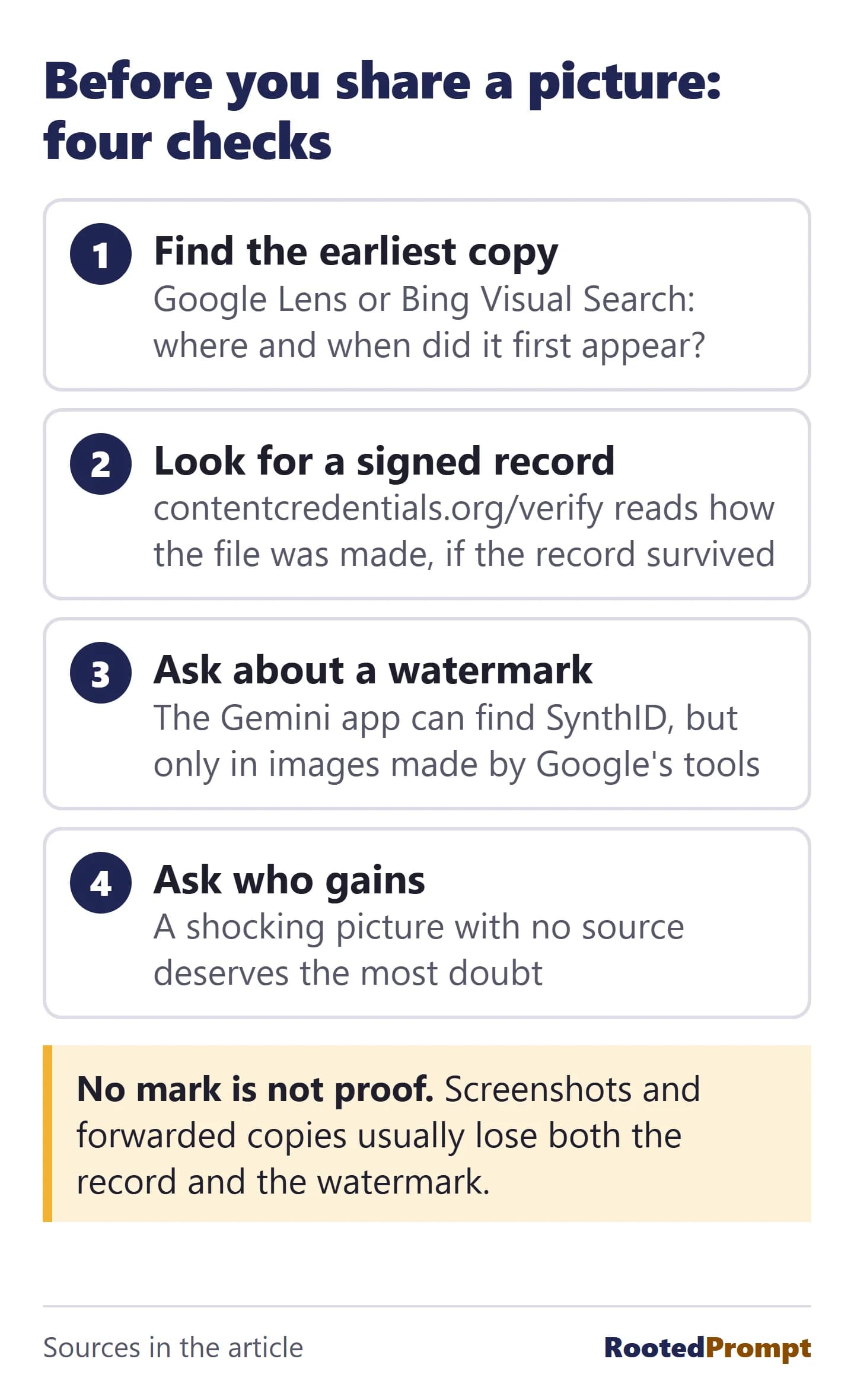
Small details can help too. In AI pictures, look at hands, writing on signs, jewellery and the edges of hair. But these clues fade with every new version of the tools, so treat them as hints only. The question that never fades is the fourth one: who gains if you share this, and where did it come from? A shocking picture about an election or a disaster, shared without a source, deserves the most doubt whether or not AI made it.
If you use a free AI detector anyway
Free detectors such as Copyleaks are easy to reach and many people will use them. If you do, use them carefully.
- Treat the score as a reason to look closer, never as a finding. Run the same text through two detectors: if they disagree, you have learnt how little the number means.
- Do not paste someone else's essay, application or private writing into a free detector without their permission. You are handing their work to a company.
- Check the facts instead of the style. AI text often contains confident mistakes, such as a law that does not exist or a reference to a paper nobody wrote. Checking two or three facts tells you more than any score.
Behind every detector question is a bigger one: who made this, and who answers for it? Our guide to how things are really made today takes that question further.
Questions people ask
None has published independent error rates for the people most likely to be wrongly flagged, such as second-language English writers. Treat every detector, free or paid, as a rough hint and never as proof.
It can guess, and it can be wrong in both directions: it may miss AI text that was lightly edited, and it may flag your own careful writing. Your drafts, your version history and your ability to explain your work are stronger evidence than its score.
Search for the earliest copy with Google Lens or Bing Visual Search, look closely at hands, signs and edges, and ask where it came from. Forwarded pictures have usually lost any watermark or signed record, so a clean result proves nothing.
It depends on the rules where you are. Many schools and employers allow some use if you say how you used it. The problem is hiding it, or handing in work you cannot explain.
Sources
- OpenAI, New AI classifier for indicating AI-written text (with the July 2023 withdrawal note), 31 January 2023, updated 20 July 2023.
- Liang, Yuksekgonul, Mao, Wu and Zou, Patterns, GPT detectors are biased against non-native English writers, 10 July 2023.
- Google DeepMind, SynthID, read 9 October 2026.
- Coalition for Content Provenance and Authenticity, Verify Content Credentials, read 9 October 2026.
Every figure above was checked against these sources on 9 October 2026. Found a mistake? Tell us through the Contact page, and we will correct it with the date.
Read next
Is it the work of AI? How things are really made today
Why "AI made it" is rarely true, and the three questions to ask instead.
How to use ChatGPT for your small business
Brief it like a new helper, check it like a manager, and never paste a customer into it.