Can AI build a website or app for you?
Yes, an AI tool can turn one sentence into a first draft of a website or a simple app, and that draft is genuinely useful. But a draft is not yet a product. Payments, security, testing, hosting, the law and upkeep still need decisions only you, or someone you hire, can make. AI makes each of those steps faster. It makes none of them go away.
By the RootedPrompt editorial team. Published 9 October 2026.
Type "build me a website for my bakery" into an AI website builder and within a minute or two you will see something that looks finished: a home page, a menu of cakes, a contact form, even pictures. It is easy to conclude that the work is done.
It is not, and the reason matters to anyone deciding whether to pay a developer, learn to code or simply trust the tool. What appears on the screen is the part of a website people see. A business also needs the parts they do not see: prices that are right, payments that actually arrive, customer details kept safe, a page that loads on a cheap phone, and someone who fixes it when it breaks.
So the useful question is not "can AI build it?" but "which parts can AI speed up, and which decisions are still mine?" This guide answers both, by following one small business from the first prompt to its first real order.
What AI website builders and coding assistants do well
Plenty of people across the region are asking. In the week we wrote this, "ai site builder" was searched about 1,300 times a month in Nigeria and 720 times a month in Kenya, and "can ai build a website for me" was among the first suggestions Google offered in Uganda, Kenya and Nigeria (Google Keyword Planner and Google autocomplete, read 9 October 2026).
Two kinds of tool answer the question, and both are worth using. AI website builders and AI app builders, offered by companies such as Wix and Durable, ask a few questions about your business and draft pages, text and pictures that you then edit. Many have a free plan to start. For a simple information site, that can turn days of work into an afternoon.
AI coding assistants, such as GitHub Copilot, ChatGPT, Gemini and Claude, write, explain and fix code. They make a developer faster, and they help a beginner understand what a piece of code does and why it fails.
Both are strongest at the visible layer: the layout, the first version of the words, the code for a form. That is why the demo looks finished. It is also why it can mislead, because a demo is judged by how it looks, and a business is judged by what happens when a customer tries to use it.
A note on independence: the people behind RootedPrompt also build website software for small businesses, so we do not rank or recommend any website builder by name. How we write explains more.
Follow one order, from prompt to payment
Take an example. Say you run a small bakery in Ntinda, in Kampala, and you want customers to order a birthday cake online and pay with mobile money. You open an AI builder and type one sentence. The picture below shows the kind of page that comes back.
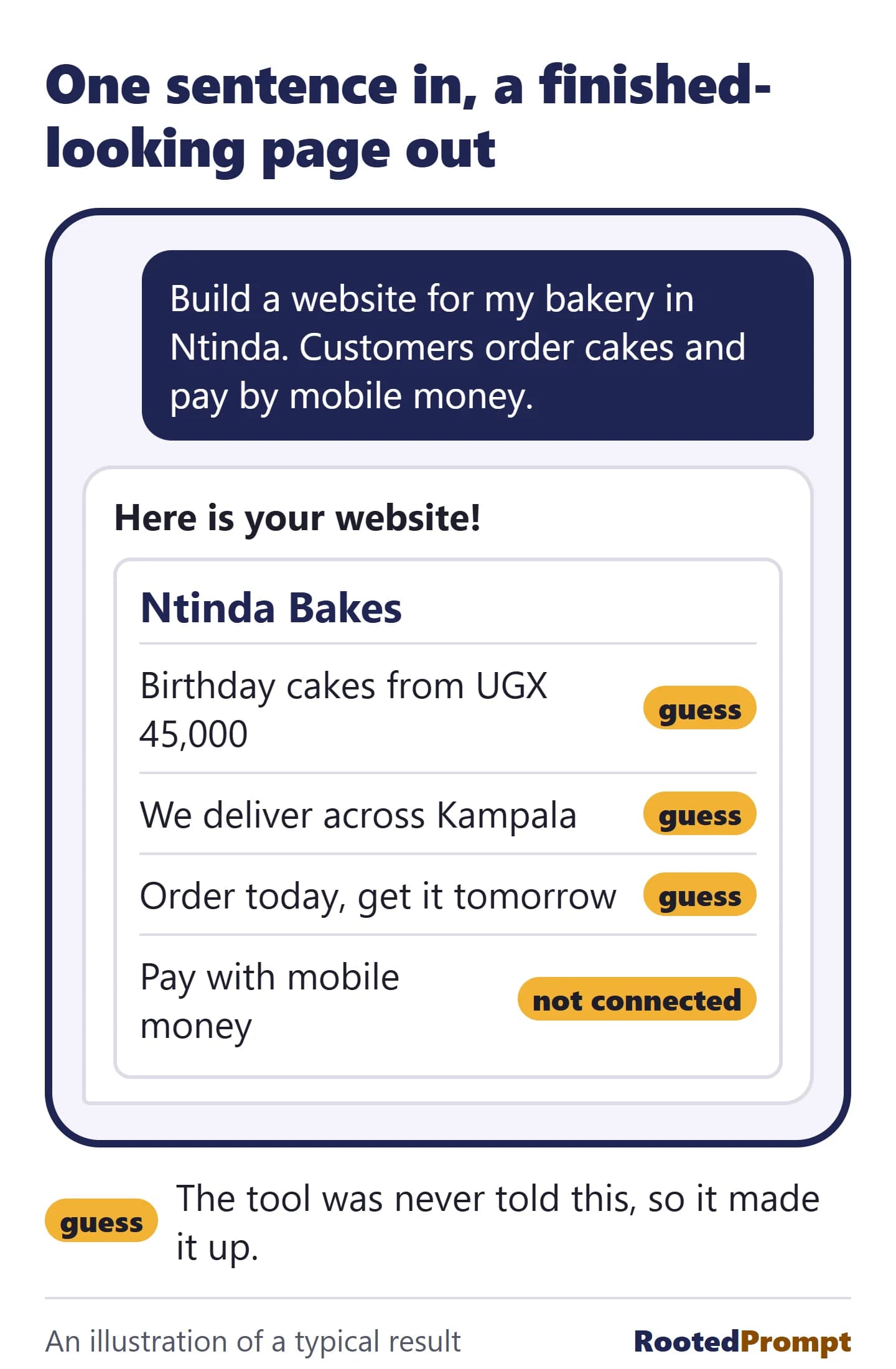
The page looks right, but read it the way a customer would. The tool did not know your prices, so it invented some that sound plausible. It did not know you deliver only to a few nearby areas, so it promised delivery "across Kampala". It did not know a decorated cake needs two days' notice, so it offered next-day delivery. And the payment button is a picture of a button: nothing is connected behind it.
None of this is the tool misbehaving. An AI tool fills every gap you leave with the most likely-sounding guess, and a customer cannot tell your guess from your promise. The fix is quick once you see it: give the tool your real menu, prices, delivery areas and rules, and it will rewrite the page around them.
That lesson applies to every AI tool, not only website builders. The more of your own facts you bring, the better the result. Gathering your content comes before you open the tool, not after.
An AI tool fills every gap you leave with a guess, and a customer cannot tell your guess from your promise.
The steps a prompt cannot take for you
Now the order form has to take real money from real customers, and this is where the draft stops and the product starts. Each step below needs a decision or an action from a person. AI can help with almost all of them, as the strip shows, but it finishes very few.
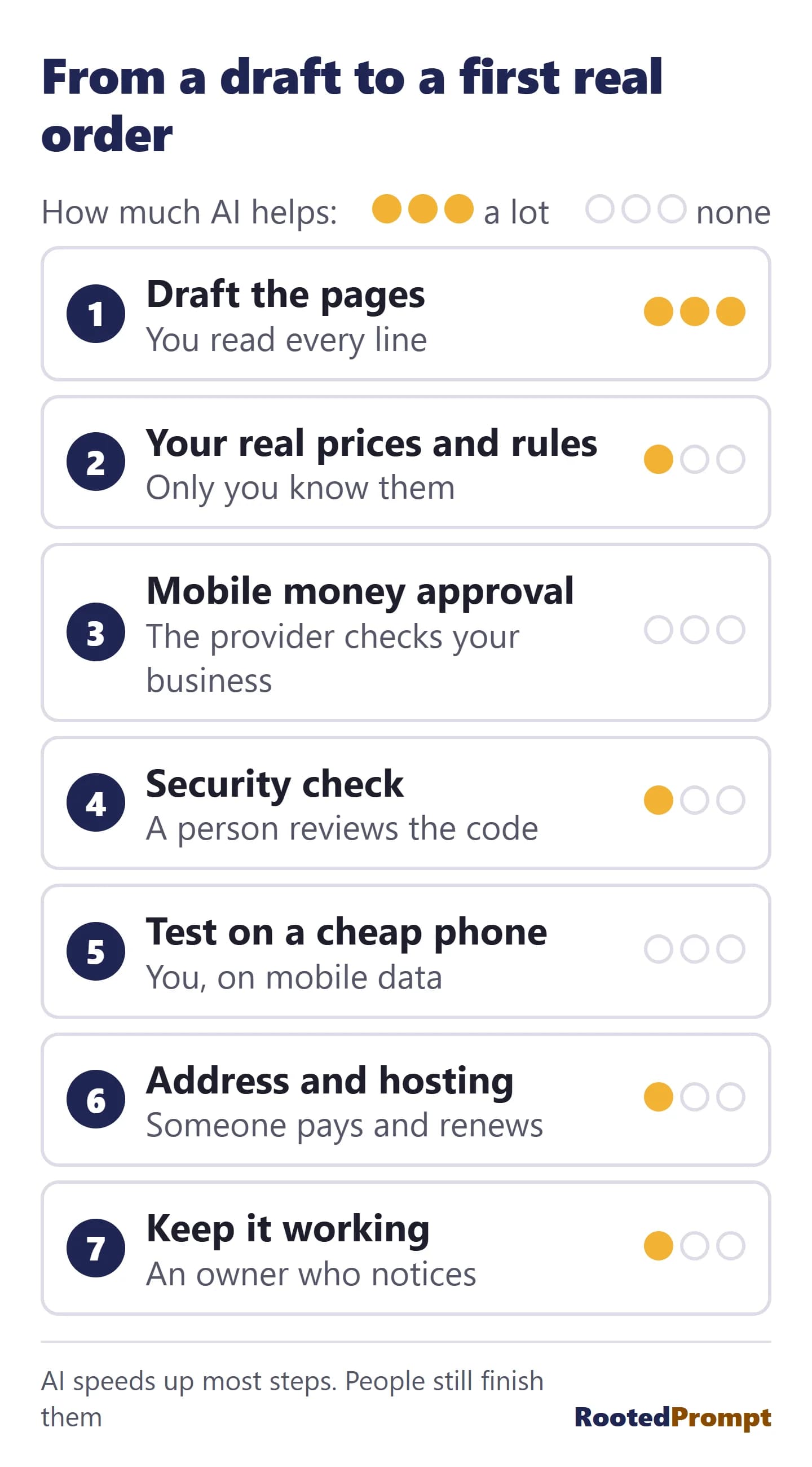
Payments. Taking mobile money is not a line of code you can prompt into existence. Safaricom's Daraja portal for M-Pesa and MTN's MoMo developer portal each let you build against a test system first, and give live access only to a business they have checked. Paystack, which serves registered businesses in Nigeria, Ghana, Kenya and South Africa, works the same way: a new account starts in test mode, and goes live only once its compliance documents are verified. The checks take longer than the code, so start them in the first week. AI can explain the steps and draft the code that talks to the provider. It cannot get your business approved.
Security. Code that works is not the same as code that is safe. When Veracode tested code written by more than 100 AI models, 45% of the samples failed its security tests and carried well-known weaknesses. The newer and larger models wrote working code more often, but they were no better at writing secure code (Veracode, July 2025).
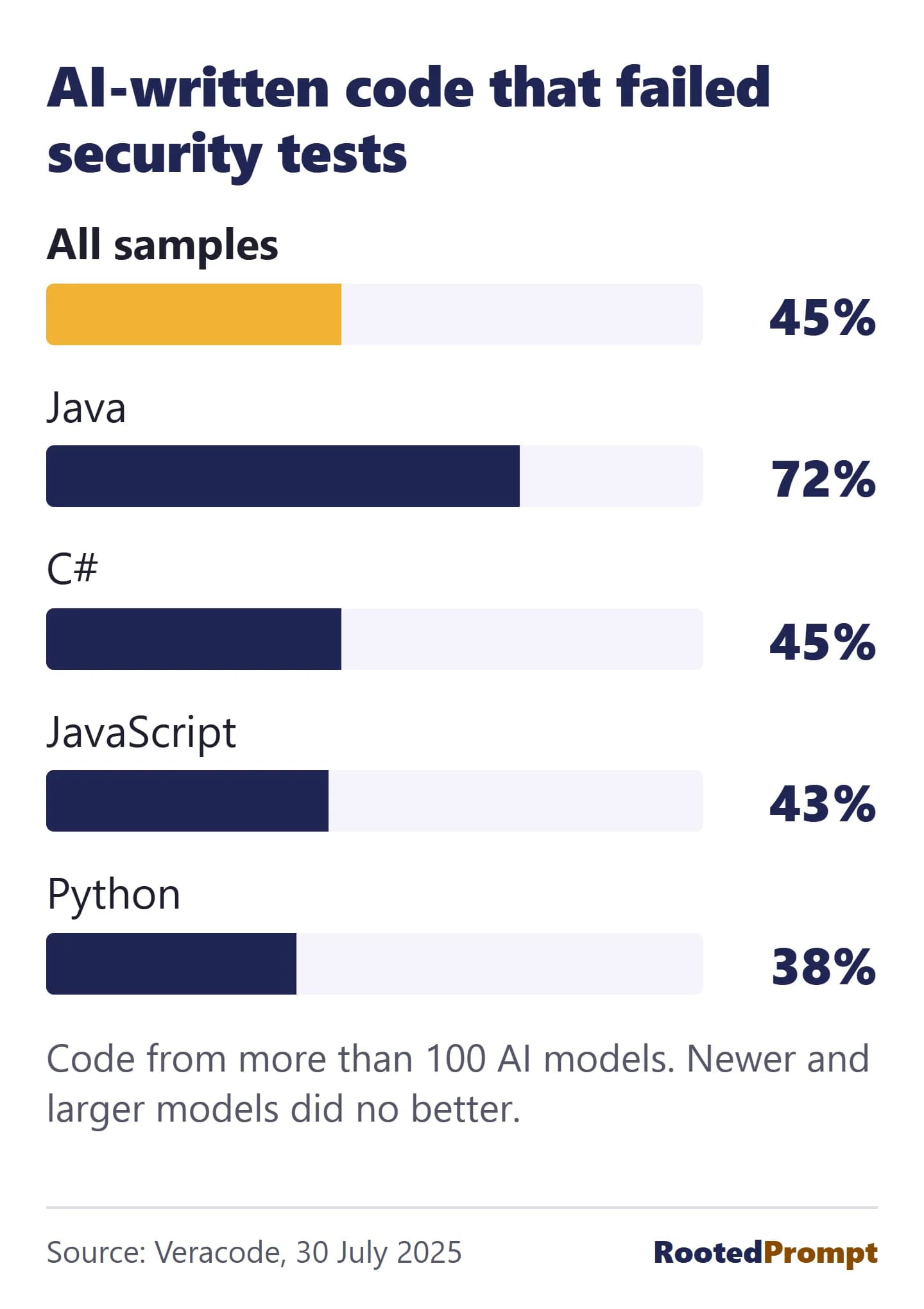
The weakness that matters most for a small business site is the one in the order form. Asked to write code that shows visitors what was typed into a form, the models failed to guard against a common attack, cross-site scripting, in 86% of the relevant samples. If your site stores customer names or phone numbers, someone who understands this has to check how it handles them.
Testing where your customers are. A page that loads well on office Wi-Fi may stall on a busy mobile network or an older Android phone. Open your site on the cheapest phone you can borrow, on mobile data, and place a real order from start to finish. No AI tool can do this for you, because it is not holding the phone.
An address and a home. A website lives on a server someone pays for, at a domain someone renews, usually every year. When either lapses, the site disappears, and so do the links your customers saved. Decide who owns the account and who gets the renewal reminder.
The law. The moment your form collects names, phone numbers or orders, your country's data protection law applies, and in Kenya and Uganda many businesses must also register with the regulator. Our guide to data protection laws in the seven countries we cover sets out who must do what.
Upkeep. Prices change, a payment provider updates its system, a form quietly stops sending. A product needs an owner who notices and fixes it. AI is good at helping you work out a fault you describe. It will not notice the fault for you.
What only you know. Which customers get credit, which cakes sell out in December, what to say when an order is late. No model has this, because it lives with you, and it is what makes the site yours rather than a template.
When a prompt really is enough
None of this means you need a developer for everything. A prompt, followed by your own careful checking, is often all you need for three kinds of project.
- A simple information site: who you are, what you sell, where to find you and how to call. Check every fact before you publish.
- A prototype to show a partner or a funder what you mean, clearly labelled as a draft.
- A tool only you use, such as a calculator for your own prices, where a mistake costs you and nobody else.
Nor will search engines hold the tool against you. Google's guidance says it rewards helpful, original content however it is produced, and acts against content made mainly to manipulate search results (Google Search Central, February 2023). The test is not "was AI used?" but "is this page true, useful and checked?" The same test runs through how things are really made today.
How to use AI to get there faster
If you are building something people will rely on, let AI do what it does well and keep the decisions for yourself. In this order:
- Write down, in plain words, who will use it, on what kind of phone, and the three things they must be able to do.
- Gather your real content: prices, photos, delivery areas, opening hours, refund rules. Paste them into the tool instead of letting it guess.
- Let the AI draft the pages, then read every line as your most careful customer would.
- If you will take payments, contact your mobile money or payment provider in the first week. Their checks take longer than the code.
- Read your country's data protection rules before you collect a single phone number.
- Test on a cheap phone, on mobile data, with a real order, before you tell anyone the site exists.
- Decide who checks the site every week, and who renews the domain.
Done this way, AI takes days off the work and you stay in charge of what your customers see and pay for. To get better answers from AI tools in daily work, read how to use ChatGPT and other AI tools in a small business.
Questions people ask
Many AI website builders have a free plan that drafts a site at no cost, usually on the builder's own address and with its branding. A domain of your own, payments and more pages usually cost money. The checks in this guide apply whatever you pay.
It can write code and explain how to put it together, and the free plan is enough to try. You still need somewhere to run the app, a way to publish it, and someone to test and maintain it. For an app on Google Play there is also a developer account and a review.
For a simple information site, often not. For anything that takes payments, stores customer data or must work every day without fail, yes. AI makes a good developer faster. It does not replace the judgement of someone who knows what can go wrong.
It can draft the code, but the provider has to approve your business before you can take real money, and someone has to test the payments from start to finish. Plan for the paperwork as well as the code.
Google judges the page, not the tool. A site made with AI that is accurate and useful can rank. A site full of unchecked or copied text will struggle, whoever wrote it.
Sources
- Veracode, Insights from 2025 GenAI Code Security Report, 30 July 2025.
- Google Search Central, Google Search's guidance about AI-generated content, 8 February 2023.
- Safaricom, Daraja developer portal (M-Pesa APIs), read 9 October 2026.
- MTN, MoMo developer portal, read 9 October 2026.
- Paystack, How to activate your business, read 9 October 2026.
- Paystack, What is Paystack and how does it work?, read 9 October 2026.
Every figure above was checked against these sources on 9 October 2026. Found a mistake? Tell us through the Contact page, and we will correct it with the date.
Read next
How to use ChatGPT for your small business
Brief it like a new helper, check it like a manager, and never paste a customer into it.
Data protection laws and AI in Kenya, Uganda, Nigeria and beyond
Seven countries' data protection acts, who must register, and what they mean for your AI use.